Become Sea Glass: Brave the Waves this Year!

Many years ago when I was training in psychology, I had the idea that as the years went by I would get better at what I did and it would all feel more polished, more perfect, more decisive. I had a picture of myself finishing my training all bright and shiny. But that’s not what happened. Instead of bright and shiny —I became more and more like sea glass.

Sea glass is beautiful. Everyone loves sea glass, and everyone wants to find sea glass, but no one wants to become sea glass. It is worn and shaped by the forces around it. It is beautiful because of what it has endured. The original colors change, but become something even more beautiful. But sea glass is never bright and shiny. It is not perfect glass. In fact, it is broken glass—the furthest thing from perfect.

In my training I had my rough edges worn away from the hours and people and experience. And mostly my mistakes. Hundreds and hundreds of mistakes. Things I should have said and things I shouldn’t have said. Thousands of hours of good intentions and hundreds and hundreds of misses and repairs. Years of training had my heart become softer and my thinking less definitive. It was nothing I could have imagined when I began, and yet as I headed out into my career I was grateful.

Sea glass isn’t like regular glass. It is sturdy. It no longer breaks easily. The only way to become sea glass is to put yourself out into the surf and let yourself get hit by wave after wave. Through all seasons and all storms. You need to get buried by the beach pebbles and rolled around in the stones. You need to get pounded by the surf, and hit by the wind, and scorched by the sun.

I have been thinking about sea glass as I head into my goals this year in this season of change. So much of what can get accomplished in terms of change or healing or growth is our willingness to put ourselves out into the surf and let the waves crash over us. Healing requires this courage—to keep putting yourself in the space of healing, keep risking the conversation, keep tolerating the emotions, keep learning new behaviors.

And all growth means letting yourself make mistakes. Hundreds and hundreds of them. Letting yourself roll around and crash on the stones. Letting your courage help you wear those rough edges off, help you reveal your deep colors, help you become sturdy.

Beach glass takes time. On the beach in Maine in the summer, when you find a piece of glass that is still shiny, you throw it back in. You give it more time. And thinking about this reminds me that maybe the goals that I have been struggling with are just pieces of glass that need more time. I need to throw those goals back in this year. Let the surf hit them again. Let myself struggle and make mistakes and run up against hard edges—and let those mistakes and hard edges soften me, and help me bring out my beauty. I encourage you to do the same.

© Gretchen L. Schmelzer, PhD 2023/2014

Stop. Breathe. Reflect. Resolve.

On this morning’s run I got a wonderful sighting of a hawk, high up on a telephone pole. I am on an island and over the dunes I can see out to the water. This morning the water was calm—almost lake-like. The air was heavy waiting for rain. High up on a telephone pole, the hawk was looking out to sea: looking for fish, pondering, scanning the horizon in the distance. He sat solid—still. I followed his gaze as best I could. I looked out at the horizon line. It looked endless-and impossible to fully take in.

Perhaps I was struck by the hawk more this morning than most because today is the day for looking out—or looking ahead. Everyone is asking about your plans for 2023—what do you want? What resolutions do you have? I envied the hawk his keen sight—wishing for a clarity of view that I imagined he had. But as I watched him longer (and got a bit of a respite from my run) maybe what I envied even more than his sight was his stillness. His ability to stop long enough to slow down and really see.

If you can take anything from the wisdom of hawks—this is probably one of the best. How to stop and be still. How to reflect and see. Here’s the thing: I have found that in most cases it isn’t that you don’t know what to do in difficult situations or in planning next steps. It is that you almost never slow down enough to know what you know. Most adults have accumulated a lot of experience – in their work, their lives, their healing. But you are always moving forward to the next thing—always looking for the next problem to solve. And often, looking for the answer outside of yourself—looking for an easier answer, or the right answer, or what other people think is ‘the best practice.’ Forgetting that you often have decades of experience to bring to the issue you are grappling with. Ignoring the vast horizon of information that you carry with you.

So, as you prepare for the year ahead, I want to stop you.  I want to slow you down. I want you to sit still. Sit hawk-still and look out on the horizon of your last year. I want to nudge you to take some time to look back and reflect before you begin to plan for what you want to do next.

If slowing down and reflecting isn’t your thing—you aren’t alone. In her article on why we should make more time for reflection (even though we may hate doing it)-- Jennifer Porter notes that the most common reasons that we don’t like reflection:  we don’t understand the process of reflection, we don’t like the process of reflection, we don’t like what we see when we do it, and we have a bias toward action[1]. But here’s something you may not know: research shows that reflection was more effective in supporting future action than additional experience was[2]. And while we often have a bias in our reflection on what went wrong—we learn important things when we reflect on both our successes and our failures[3].

Reflection is the act of slowing down to know what you know—to observe what you have done, what worked, what didn’t, and what you have come to understand about how to do what you do, and how to understand the meaning of what you do. Reflection supports both your ability to do the things that are important to you—and reflection supports the way you feel about yourself and your effectiveness.

So before you plan the year ahead—please take time to reflect. You could start by going through your dayplanner or calendar and even seeing what you did and who you did it with this last year. You could do it alone. You could do it in conversation. Make a list. Or write it on flip chart paper. Or make a slide show. You will be surprised by some of it—you will be surprised by what you have already forgotten.

Or if you are seeking even more structure you could use the framework offered by Burnett and Evans in their book Designing a Life. They use a dashboard of four categories: Health, Work, Play and Love. And I encourage you to reflect on the categories fully over the past year. What did you do? Highs and Lows? Surprises?  What worked and didn’t? What you learned? What you lost and gained? What you would have done differently and why?

In my 5-phase model of healing from repeated trauma I strongly encourage everyone to start with preparation: gather your resources and build a foundation for the important work of healing. This foundation helps you sort through what did happen and what didn’t happen and helps you untangle the ways you protect yourself and can often get in your own way. And this transition into a new year is no different. You need to build a strong foundation from which to spring into what you want and need next. And this is as true for teams and organizations as it is for individuals.

Perhaps, because it is winter and most of the world is fallow, we forget the wisdom of nature and growth and planting new things. We aren’t reminded through our current actions how to support growth. You don’t just leap in to action. You reflect on what you grew and what helped. But most importantly you turn over your compost and add it to your beds—and then you till that compost into the soil so new things can grow. This is the invisible work of gardening—of taking the what is old and digested to support new growth. And this is the invisible, but crucial work you need to do: to turn over your learning and digest it enough to take forward.

 © 2023 Gretchen L. Schmelzer, PhD


[1] Porter, J. (2017). Why you should make time for reflection (even if you hate doing it). HBR March 21, 2017. 

[2] Di Stefano, G., Gino, F., Pisano, G., and Staats, B. (2014). Making Experience Count: The Role of Reflection in Individual Learning. HBS Working Paper 14-093.

[3] Cannon MD, Edmonson AE. 2001. Confronting failure: Antecedents and consequences of shared beliefs about failure in organizational work groups. Journal of Organizational Behavior, 22: 161–177.  Edmondson AE. 2011. Strategies for learning from failure. Harvard Business Review, July-August: 48– 56.


Trauma and Holidays: On Giving and Receiving

When I was a psychology intern, one of the psychiatrists on the unit used to describe the problems of most of the inpatients as a “closesness-distance” problem. They couldn’t find the right distance from people—people were either too close or they were too far away. This dilemma always reminded me of animals who had been treated badly—the cat wanted to get close to you, but when you tried to pat it,  it would run away.

Trauma almost always creates a closeness-distance problem, especially repeated trauma. Surviving trauma requires creating protections—and many of these protections are about keeping others out. It doesn’t mean that there isn’t the longing for closeness—or the longing for connection. But the protections that were in place for so long meant that you lost the practice of connecting. Lost the practice of letting people close—letting in the love from others.

I am thinking about this because the holidays are upon us. We are in the midst of Hanukah and Christmas is approaching. It is the season of giving. And it is also the season of receiving. And where trauma creates a closeness-distance problem, it also usually creates a giving-receiving problem.

Giving and receiving are really the actions of closeness-distance. In mundane terms, giving and receiving can be merely acts of communication or acts of everyday care. And for people who have experienced trauma I have noticed something important: they often can give, but they can’t receive. They can reach beyond their walls, but their walls don’t let anything in. It’s not plain stubbornness, or even deliberate protection: it is a sheer lack of practice. It is a lack of neural pathways. It is a lack of brain receptors for the good, for the positive, for the kind.

It is why if you love someone who has experienced trauma, they never seem to hold on to the good things that you say or do. You tell them you love them, you tell them the good you see in them, you do kind things for them. And when they are upset they say that no one loves them. It is as if they don’t remember anything you said or did. And this can be horribly frustrating for everyone.

It’s not that they didn’t hear you when you said it. It is that it didn’t stick. They couldn’t feel it, and it couldn’t register as a real memory. This is why the work of healing from trauma is so important—so you can get to a place of taking things in. And it is why it takes a long time. Because you are, literally, rebuilding a brain.

So I think it is really important at the holidays to acknowledge how hard it can be to receive. Because receiving a gift is risking closeness. It is the hurt cat risking being patted. But if receiving is to be healing then you have to slow down and breathe and take in the kindness as much as you can. And you don’t have to start with gifts. Start with anything people give you: a smile—breathe, take in the smile and smile back. Or hello, or Happy Holidays, or Merry Christmas! Each time someone gives you the gift of any kindness—acknowledge the gift, breathe and take it in like a long drink of water. Drink it way, way into your roots like a tree that has lived through a drought. Because it has. The thing about healing is there isn’t a state of hurt and then a state of healed. Healing is about creating a constant state of mending.

And if you are someone for whom the whole receiving thing is too scary or too overwhelming—then practice with giving. Giving can begin to help you build your closeness-distance muscles. But you need to work on feeling the feelings that go with giving for you. Say something kind—breathe and feel the kindness you are giving. Do something kind and take in the feelings of the action. The practice of giving can prepare you to eventually work on the  practice of receiving.

Understanding the impact of trauma on giving and receiving can give you a way to understand some of the stress that can come up at the holidays. It can help you be more compassionate with yourself or your loved one who has experienced trauma. it can help you slow down and actually begin to heal through the holidays, rather than protect yourself from them. You can use the moments that the stress flare up as a way to help yourself check in and say, “What’s happening right now for me? Too Close? Too Far Away? Difficulty Giving? Difficulty Receiving?” These questions can give you a way to talk with yourself differently and ways to coach yourself differently. The questions, and the answers to them may also give you language to talk with your loved ones about the holidays and the more mundane days of giving and receiving.

© Gretchen L. Schmelzer, PhD 2022/2015


Be the light you wish to see...

There are two ways of spreading light: to be the candle or the mirror that reflects it
— Edith Wharton

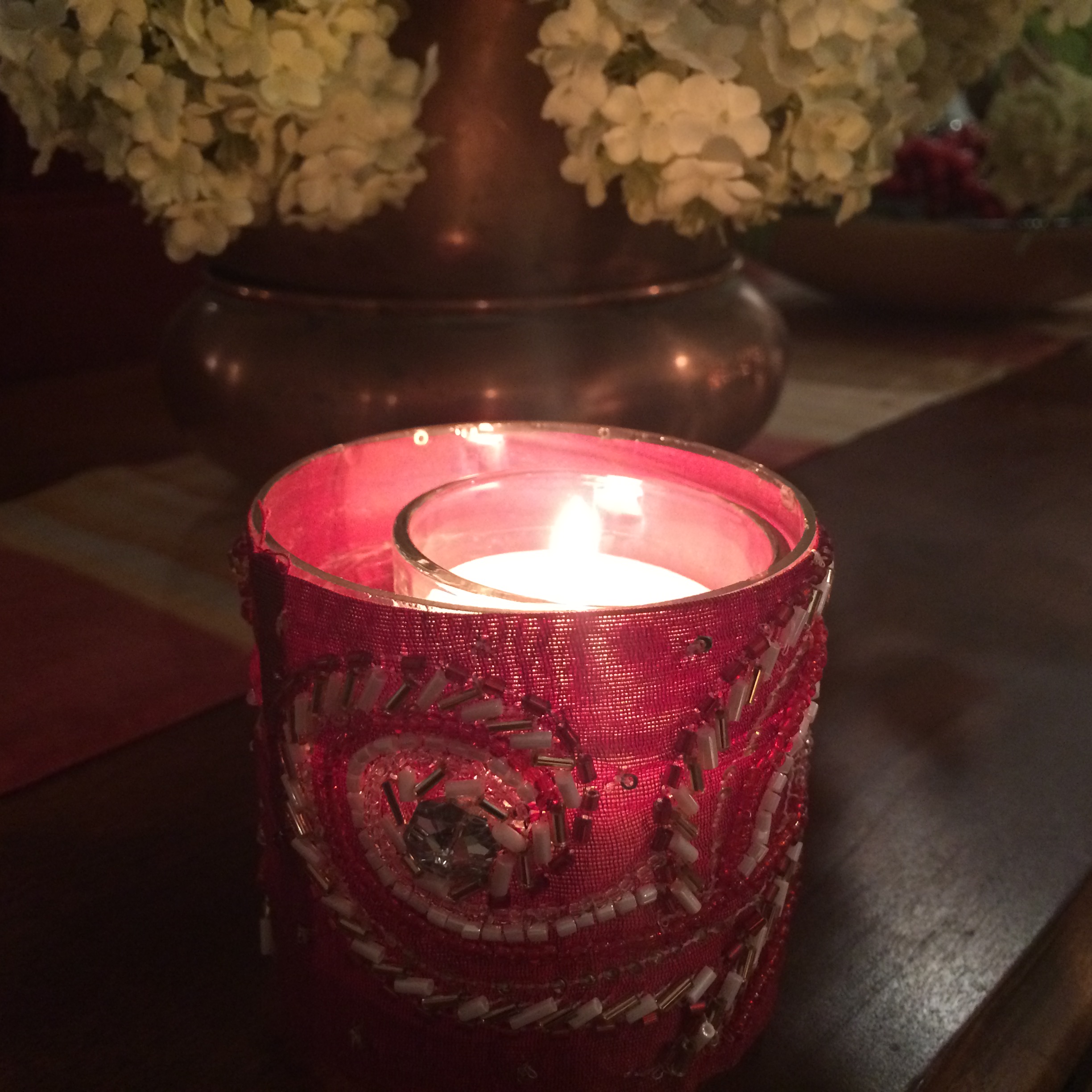
The season of lights. The festival of light. How light gives us hope in darkness! All it takes is one lit candle to change the feel of loss into hope, of dark into light. Just one candle can make all the difference.

As someone who was not raised Jewish, I have often wished that the Hanukkah story had become more secularized—so that we all could have borrowed the faith and devotion and hope from the story of the oil and light lasting the eight days. There is such power in them: faith and devotion and hope.

And somehow no matter how big the occasion or small the occasion, candlelight transforms it into something more powerful, more hopeful, more connected to the history of all people who have had faith and hope. This fall I watched a young friend turn 8 and blow out candles on her cake and you would all recognize the look of anticipation and joy before she blew them out—that look is universal. Her face lit with candlelight.

And here at the holidays—shrouded in lights, after an autumn filled with so much darkness, the question is: can we bring our own light? Can we spark the light in others? Can we connect to the light that inspires us? If we are feeling dark, we can light one, simple, single candle within us?

I think that we always think too big when it comes to faith and devotion and hope. I think we think grand, and we need to think in terms of one single candle. One light that can, and often does, like the oil, last much longer than you can imagine.

You can use any light within you to light the candles around you. You can use the love of anything that brings you joy: your relationships, your work, your pets—whatever warms your heart. And then you can bring that light to another and warm their heart. I have so many memories of people who I didn’t know, who smiled at me as I came out of a building, or into work, and they changed my day. They made me feel seen, and loved, and “okay” on days that I didn’t feel that way. They took their light, and lit my candle. In such small increments you can bring light: to the people near you, to the person waiting in line with you, to the cashier, to the toll taker on the Jersey turnpike. Wherever. Light a candle. Bring your warmth.

Edith Wharton said that there are two ways of spreading light: to be the candle or the mirror that reflects it—so if this is a year that you can’t seem to light your own candles or anyone else’s—then do what you can to reflect any light you see. Just take in what you can, reflect what you can and reconnect with your light. We all have those years—when the best we can do is reflect.

This time of year can be so busy, and come with so much expectation. There can be moments of such longing, for people, for times past, for expectation unfulfilled—as well as real feelings of sacrifice and hardship and loss. You can’t fix it or fill it or change it—not all at once, if at all. But you can bring some light to it. You can bring your light to it. And the world will be warmer. And more hopeful. 

© Gretchen L. Schmelzer, PhD 2022/2016