
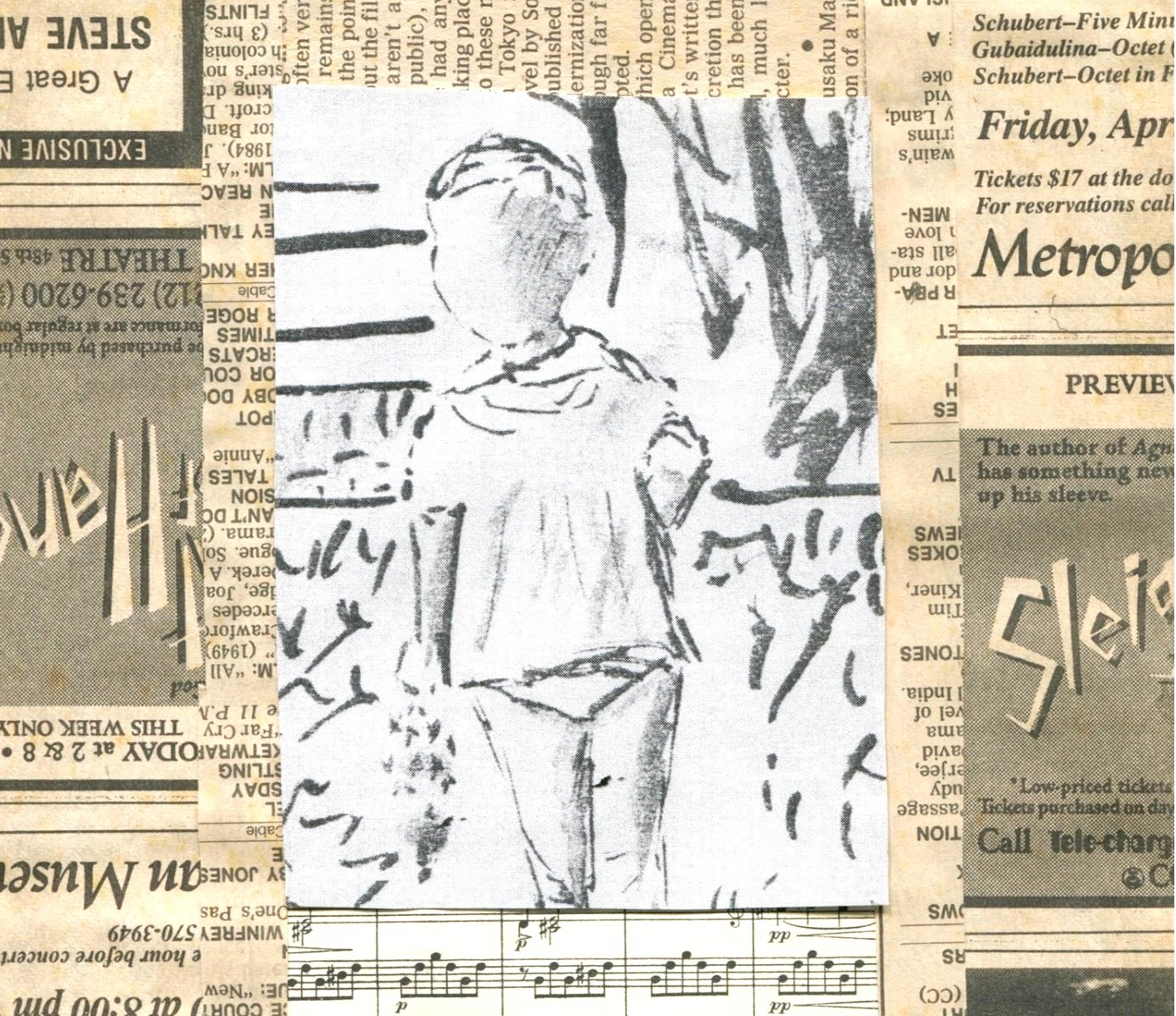
The Healing Power of the Container: The Frame as Art

In one of my very first blog posts I wrote about an art class I took in college—called Methods and Materials. For my final project I ended up doing giant watercolors of old family pictures—and our class got to have a show of our work in the art building. I had two whole walls.

Over the course of the class I became enamored with Chinese hanging scrolls—not so much what was on the inside of the scrolls, but with the outside—the patterns and color block that made the framework for the picture. I thought the frames were beautiful, sometimes more beautiful, than the picture. I made collages of the frames with nothing in the center. And when it came time to hang my show, I created giant hanging scroll frames made of newsprint and maps and sheet music and put my watercolors in the center. I wanted my family pictures to have a framework, a container— something to hold them tight.

I had no idea then that I would end up traveling to China and Southeast Asia and I now have all kinds of scrolls hanging in my house. Some of them are Cambodian, made of fabrics, patterns of silk—hanging from old cross pieces of looms. And some are traditional Chinese scrolls with paintings of bamboo or tigers. They have replaced the paper ones I created in art class.

As a consultant and therapist I often talk about containers or frameworks. These things are the invisible structure that allows change to happen. Not unlike art—we don’t always notice the frame—we take it for granted—the framing of the canvas, and then the frame of the painting—two frames providing structure and support and protection.

And in many ways the container should be invisible and taken for granted. It should be so interconnected that you think it is part of the art.

What do I mean by container or framework? When I teach people about containers and helping I go back to being a lifeguard. When I worked as a lifeguard I had a rule that there should be one lifeguard for every ten people. At this ratio, there was safety. A lifeguard can watch ten people and interact with ten people. Interestingly there is a magic number for human memory which is 7 plus or minus 2. It is what the human mind can easily hold in memory, and I have found that human beings somehow know if there are enough lifeguards or group therapists or consultants of group members to keep them in memory. When we unconsciously know that we are held in memory, we have the experience of knowing there is an emotional lifeguard. And so I have found the lifeguarding ratio to be the best container for work to get done by groups. When you have enough staff, or therapists or consultants—the group does its work and takes risks. When the ratio goes down, the work shifts back to being more superficial.

And the container can also be too tight. If a painting were all frame and crowded out the painting—that wouldn’t be right either. If there are too many helpers, therapists, consultants—people don’t feel safer, they feel scrutinized. In this scenario, they are held too much in memory and they get self-conscious and they don’t do as much work either. So in creating containers you have to strike a balance.

And it is a balance that we participate in whether we are the helper or the one being helped. The helper provides the container in the beginning so healing can happen—it is the cast or splint that you can’t see, but which has to be thoughtfully put into place and adjusted as needed. Tighter when we are in crisis, looser as we heal. And if you are the person who is helping you have to deeply understand that the container is as much of the work as anything else. This allows you to honor this work. And, like the frame of the canvas--it is the prerequisite for any work to happen. As the person who is getting help you have to learn to lean on it, lean in to it, and let it become something you trust. You come to depend on it, and then you learn to create it for yourself. Healing is so much like the hanging scrolls that I love so much: it requires that you become the beautiful frame and the artwork inside. You are both: the container and the art.

© 2022/2015 Gretchen L Schmelzer, PhD

To Truly Leap

Of all the formulations of play, the briefest and the best is to be found in Plato’s Laws. He sees the model of true playfulness in the need of all young creatures, animal and human, to leap. To truly leap, you must learn how to use the ground as a springboard, and how to land resiliently and safely. It means to test the leeway allowed by given limits; to outdo and yet not escape gravity. Thus, wherever playfulness prevails, there is always a surprising element, suggesting some virgin chance conquered, some divine leeway shared. Where this “happens,” it is easily shared and acknowledged.
— Erik Erikson

All growth requires leaps. And because healing is really growth on a careful, remedial plan, healing requires lots of leaps too. The first leaps are leaps of faith— in trusting yourself, in trusting your healing providers, in trusting a process of healing that you can’t really understand, but know that you need. These leaps of faith are huge, and the thing about leaping is that you have to do it a lot to believe in it. If you have ever watched baby goats, or sheep or foals, they try their legs out constantly —they buck, they leap and they land. They wiggle in the air. They leap and they find their ground. Over and over.

 The thing about leaps is that they are both frightening and exhilarating. Like the first time you learn to jump off the high dive, or ride a bike. Leaping means testing out the laws of nature— testing out how you interact with the world. And in healing from trauma, the leaps are often to test out a world that does’t run on the old laws of trauma. Trauma creates a world with its own natural laws—and you know these laws in your bones. You know what will happen when you make the wrong move, you know what will happen if you speak. But in a world without trauma, you actually don’t know the rules. When you first start to leap — to speak up for the first time—to say what is true for you—to risk asking for help— to say “no” —risk being vulnerable— all the things that the laws of nature of trauma forbid: it will be both frightening and exhilarating. These things which look so average from the outside are truly leaps for healing.

And just like the baby animals learning to use their legs and understand the world: you need to enjoy those leaps. Savor the exhilaration. Take a moment to feel proud of the leap. Smile. Wiggle in your chair. Pat your self on the back.

Trauma is such serious business and healing requires leaping—it requires playfulness. It's so counterintuitive. The only way to heal is to stretch into the unknown, to try something again and again and when you leap—you are really playing— you don’t know the outcome—for a moment everything is suspended—and then you land—and know something about the world, and yourself, and probably relationships that you didn’t know before. What leaps can you take today? How can you savor the leaps? How can you support others to play and leap?

© Gretchen L. Schmelzer, PhD 2022/2014

Mindful Mondays: Mindful Hellos

Hello. It’s one of the most common greetings. Most of us even know how to say it in at least one other language. Hello. It is the action of giving a sign of welcome or recognition. It is the action of placing our attention on someone. Or something. Today we are going to look at how we can bring more mindfulness to our day through being more mindful of our hellos.

Hellos are a beginning. A fresh start, or a re-start. A chance to see whatever or whomever you are greeting with fresh eyes and a warm heart. A chance to see something for the first time again. 

There are parts of the world where the sacred is intertwined with this intention of welcome and greeting. In Hindi there is a hello, Namaste, used in many parts of Asia and South Asia, meaning “I bow to the divine in you.” “I see the divine in you and I bow to it.”  And in the Southern Germanic Speaking world of Bavaria, Franconia, Schwabia, Switzerland and Austria they use the familiar greeting “Gruss Gott” ‘May God greet you’ and even our English goodbye is the shortened version of ‘God be with ye.’  The old German meaning of ‘greet’ was the same as the meaning for ‘bless’ and so in the same vein as Namaste a greeting was an aspirational and inspirational act. Most other hellos are versions of ‘good day’ and also bring intention to the interaction—a hope, a wish, a prayer. Bill Bryson states in his book Mother Tongue that "hello" comes from Old English hál béo þu ("Hale be thou", or "whole be thou") meaning a wish for good health. You see, no matter where you go in the world, hello is intended to renew you and connect you with health, wholeness, and the divine.

I had a teacher many summers ago on a course I took named Satish Kumar. He was a man who infused his hellos with the divine. He looked at each person he said hello to with the joy that one usually exhibits when they greet a newborn baby or a golden retriever puppy. Pure joy radiated from his smile, from his eyes. It is such a different feeling to be on the other side of that hello. His hello was medicine.

Today, see if you can slow down and bring your attention—your heart, your mind, your spirit to your hellos.  See if your hello can be medicine to the people you meet. They can be loved ones, colleagues, co-workers, the barista at the coffee shop, the bus driver, the janitor, the other person walking toward you on the sidewalk. Today, instead of saying hello on autopilot, actually fly the plane. Slow down. Take a deep breath. Feel your feet on the ground. Smile. Say hello. Say hello with your whole being. With your whole heart. And then do the most radical act of all. Wait for the hello back. Make hello a conversation. Make hello a gift. And let it come back.

Yes. Wait for the other part of the interaction. Look at their eyes. Smile. Let the hello sink in. It’s a second or two difference but the impact is immense. Say hello. Wait for the hello back. Take it in. Let it nourish you. Namaste.

© Gretchen L. Schmelzer, PhD 2022 Originally posted 2015

Gratitude in Action: Send a note of thanks this Thanksgiving

Recognizing abundance rather than scarcity undermines an economy that thrives by creating unmet desires. Gratitude cultivates an ethic of fullness, but the economy needs emptiness….it reminds you every day that you have enough…more than enough. Everything needed to sustain life is already here. When we do this, every day, it leads us to an outlook of contentment and respect for all of creation.
— Robin Wall Kimmer

Thanksgiving has always been first and foremost a harvest feast—for which we give thanks—but what if we made the act of gratitude and thanks the most figural part of the holiday? What if we created a new ritual of sending notes of gratitude and thanks. Not the kind you send out of politeness when you get a gift—though that gesture is lovely—but a note of thanks to people in your life who have helped you—have helped you become the person you are. They can be notes, or cards, or postcards, or emails. They can be long or short. They can be people you have known your whole life or people you have never met.

Take a moment first to think of a person or people about whom you would say that you wouldn’t be the person you are today without them. Think about how they impacted you. Think about the things that they did that were helpful to you. Think about how they made you feel. Think about the ways you have been able to be more of yourself or bring more of your gifts to bear on the world because of them.

Then think about the people who have inspired you. Have reminded you of your purpose, values, or faith. Have reminded you of love and courage and persistence. Think of the people whose small acts, mundane acts, generous acts made a difference in your life. Think of the writing, music, or art that has been a source of joy and energy. Think of the people in neighborhood, your town or your workplace who have made a day better for their presence in your life.

Make a list if you can—a gratitude list of people where you experienced help, support, inspiration, challenge, learning, growth or love. There’s no minimum requirement. No act of support or uplift that is too small or too large. No demand that your gratitude is new. And no demand that you’ve ever met in person. They can be people who are currently living—and they can be people who have since passed away. The only requirement for their presence on your gratitude list is that they made your life richer for being in it. And maybe they helped you make other’s lives richer too.

Abundance comes in many forms. Our current economy is designed to remind us daily, hourly, of what we don’t have, of what we need. It’s designed to make us want—to make us feel like we are missing something, or to feel hungry for something we don’t have. And this exercise—this practice of a gratitude list of who has helped me—in any way-- is a powerful reminder of how rich in resources we actually are. A reminder to feel the plenty in our lives. To feel abundance. To truly feel fortunate.

Now that you have your list—the practicality of how you want to act on it is entirely up to you—and should fit the way you like to communicate. You could write a note or a postcard and put it in the mail. You could send an email. You could call them on the phone or send a text. You could tweet or make a TikTok of gratitude. You could send a pile of them all at once this week while you are waiting for something to bake. Or you could decide to send one a day or one each week this year –weaving gratitude into your everyday life in a tangible way.

Imagine a world where notes of thanks were filling up inboxes and mailboxes. Where people felt their impact and worth.

You might be surprised how important you have been in my life….Thank you for your small kindness, it made a huge difference…… You probably don’t me, but you have made my days brighter…

But remember that above all gratitude is an act of giving not of perfection. Think small. Think simple. And embrace awkward if you need to. But above all, give your thanks.

© 2022 Gretchen L. Schmelzer, PhD