
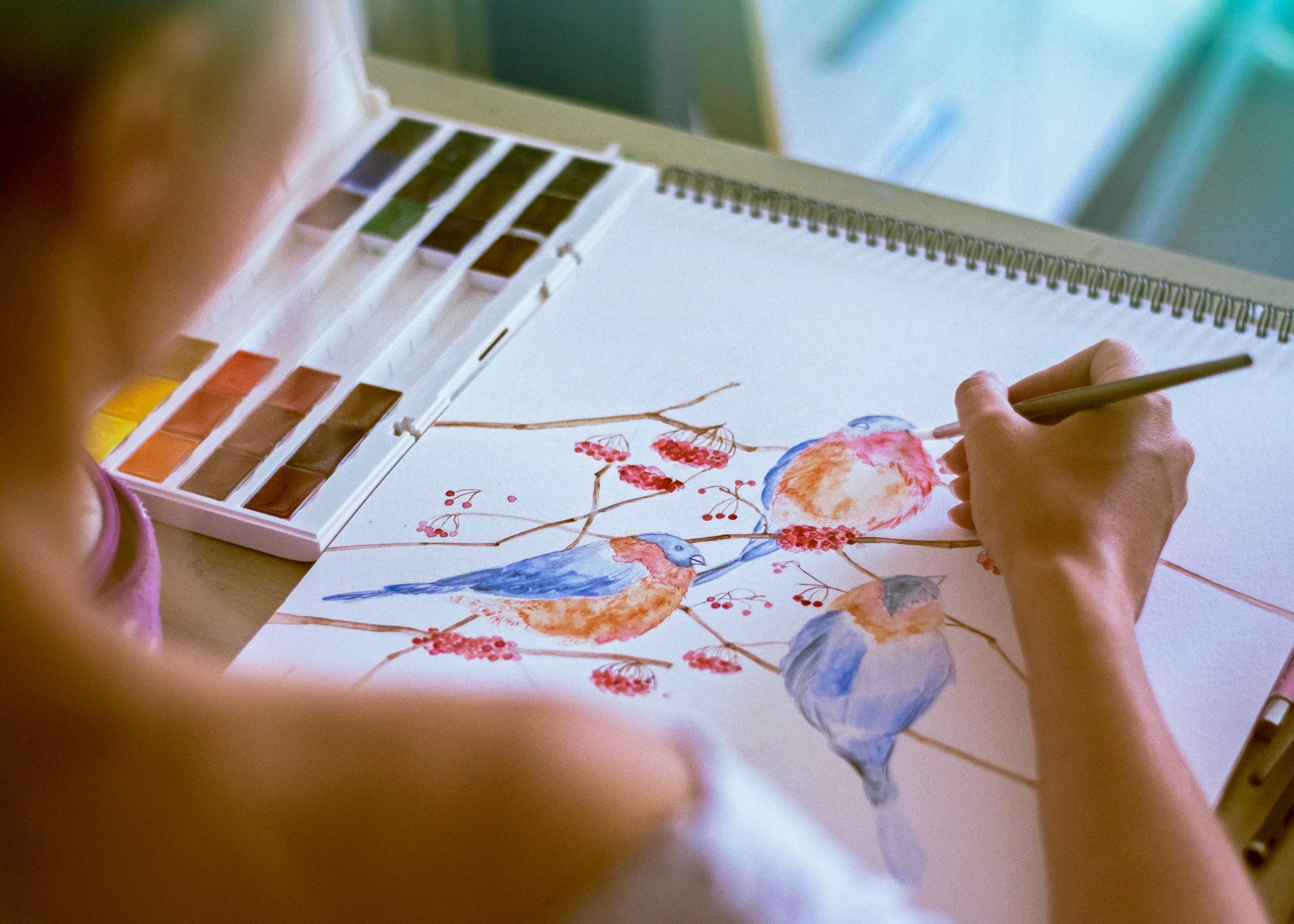
Embracing "First Drafts" for Healing and Growth

Nobody is ever meant to read your first draft. The first draft is you, telling the story to yourself.
— Neil Gaiman

Sometime before the Covid years I went to an Elementary School Science Fair—and found that I was shocked at the perfect and professional displays that the children were presenting because most of them had used PowerPoint. I shouldn’t have been. I obviously went expecting what I remembered from science fairs: hand lettered poster boards with drawings in colored pencil, dioramas made out of shoe boxes—everything hand made. But time had marched on, and new technology had entered elementary school. These projects looked polished, almost corporate, which felt jarring given the seven-year-old standing in front of me. It made me feel like something was lost, though I couldn’t put my finger on it. I confess I like seeing a child’s version of a great horned owl much more than I enjoy clip art.

Don’t get me wrong. I think kids should learn the latest technology—but there’s something about learning, about being connected to the process, about experiencing the steps between an idea and a polished product that are harder to see or appreciate when it happens automatically. The new technology makes first drafts seem unnecessary—or even too childish for children. It makes it seem like there’s always a way to get it right the first time.  

But getting it right the first time isn’t how you heal. And it isn’t how you grow.  When you heal, or grow, when you are trying to get your story out, or trying to sort what you know, or what you know now—it can be really hard. And part of what makes it hard is the lack of practice or familiarity, and perhaps, most importantly, honoring of the fact that this piece of work is just a draft. You can get hung up on truth—or you can get hung up on clarity—both of which are important, but at this phase of sorting, naming, exploring—the goal is to get out what you can—what you know at this moment—what you can bear—what you can hold.

You forget that you can write something one day and contradict yourself the next. You forget that you can write your way into an idea and get lost for a while—and not have a clear idea of where you ended up—or where you wanted to go. You forget that you may tell the same story over and over—trying to connect, not the words, but the emotions, until suddenly, one day—it all comes together.

And while you may be telling the story to yourself, you sometimes need a listener: often a therapist or someone in a helping role, or a growing role. And that’s why it’s so important in the helping and growing professions to learn how to listen, rather than (as is fashionable and satisfying) to learning how to fix. Because you need the chance to talk in drafts—to be able to have first draft conversations. Conversations where you are sorting. Where you say something and listen to it in your heart, mind and body. And then you revise. Conversations you have and then months later, you come back to—and you start again. And again.

If I go back to my experience creating a project for a science fair—to a large poster of a peregrine falcon hand drawn from a picture in the Encyclopedia Britannica—what I got through the trial and error and practice of drawing wasn’t just a drawing, it was a relationship. It was a relationship to the peregrine, one I still have today—where I am overjoyed when I see one. But through the process I was also building a relationship with myself—or with the part of me that was learning how to learn— or was learning how to persevere in the face of something challenging. Building a relationship with the part of me that cared deeply for something—to know what that kind of care feels like.

You only get a relationship with what you spend time with. Which is where first drafts come in again. First drafts are where we start all of our relationships. How can you have a relationship with your process, your story—the way you understand yourself or others—if you don’t have a practice of first drafts? How do you allow yourself to start? How do you allow yourself to revise? How do you allow yourself to start again?

© 2023 Gretchen L. Schmelzer, PhD

For more ‘first draft’ inspiration you can watch this interview between Tim Ferriss and Neil Gaiman

Or you can read the best known primer on first drafts: Anne Lamott’s Bird by Bird


What to do when your kids leave home.

They are leaving home.

The move feels so big. Sometimes it’s bigger for you. And sometimes it’s bigger for them. Camp, School, College, Apartment. Doesn’t matter. It feels huge, transformational. But even though it feels like it’s one big move, that’s actually not the way it happens. Leaving home is really done over years in the smallest of steps. Mundane steps that you don’t see as the runway to independence. It is a runway that was built brick by brick--with every goodbye and every goodnight. You and your child have been building the muscles for departure with every hello and good-bye; we are apart and we are connected.

With each drop-off and pick-up at school and at camp, your child has been building the capacity to hold his world and be held by yours—building the muscles to hold all of that in his heart. You forget that in addition to the many things your child is learning at school or at camp: math, science, history, swimming, archery—they are also learning attachment.

Attachment is one of the most important things we learn --and, unless there is a problem, one of the most invisible things we learn. Attachment is learned in the everyday back and forth of life. We teach it with peek-a-boo when they are babies and hide and seek when they are older. We teach it with every good-night and good-morning. We teach it with every mistake and every repair. It is hard to see because it changes shape all of the time. As a parent, attachment means being ballast—leaning to the side of the boat that needs to be brought in to balance. Sometimes it looks like holding and soothing and picking them up in your arms, wiping away tears. And sometimes it means holding the line, having the hard conversation, making them stretch: join a sport, get a job, pay your bills.

But at each milestone of stepping out and away, your child will walk on their new legs of attachment and feel them for the first time, again. They will wonder, “Can I do this? Can you? Will you remember me? Will everything be okay when I return? If I forget you, will you still be there? Who am I without you?” They will feel joy and pride in their new steps away, and fear and sadness at the loss of the more secure time they felt before. It is both. And holding both is really hard to learn. It takes most adults until mid-life to really have the ability to hold two truths in their arms at the same time and most kids can’t. They swing wildly between the poles—one day all excited and proud about the new adventure and the new friends, and the next day full of despair at the prospect of leaving.

And here’s the paradox for parents. We think that leaving home and the big milestones of our lives are about independence—but they are really about connection. Whether they are two, ten or twenty, your job is the same. You are already good at it. It is simple but not easy. You keep up your job as ballast. You help them hold both by holding the other: the other truth (yes, I will remember you), the other emotions (I know it’s hard, but you are learning so much), and the other end of the rope (I’ve got you, and you’ve got this, we are doing great, even if it doesn’t feel like it).

So as you send them off: to camp, to school, to college, to their new lives. Remember this. They are learning so many new things, but they are also, most importantly, learning attachment. They are learning how relationships hold over space and time. They are learning that love and care can stretch far and wide. They are learning that they exist, even when you can’t see them, and that you can hold them in your mind and heart—and they can do the same. They are learning that they carry all of the love and knowledge and resourcefulness of home in their own legs—that they can stand on their own feet and feel the sturdiness of them. And they are learning that home is woven through every cell of their bodies.

© 2023/2015 Gretchen L. Schmelzer, PhD

For a longer, wonderful read on attachment, here is an article by Robert Karen in the Atlantic. Or purchase his book, below.

A Safe and Necessary Distance for Healing

01415646-BD0A-4633-A7DC-8B8A3213B7AC.JPG.jpg

Many years ago on a work trip I woke up in the morning to the crack of rumbling thunder in the distance. It was a compelling sound: close enough to see the storm, far enough away to watch it with interest and not fear. I was far away from home —working in Dubrovnik and my hotel room looked out over the Adriatic Sea. My room had a small balcony that was covered and I took my coffee out and sat and watched the storm as it dumped rain on the mountains across the way, as lightning shot down and thunder echoed along the coast. I am not sure why, but sometimes you can feel even safer, even more solid—when you are in a storm, but have just enough distance and safety to take it in. A safe distance from a storm can feel safer than when there is no storm at all.

For some reason, this storm so very far from home reminded me of how much I loved being in elementary school when there were thunderstorms. It would be nearly dark outside and you could watch the pouring rain through the big windows of the school, and yet inside it was bright and cozy and colorful. School was my safe place—so I think I could actually feel the dark and hear the thunder and experience myself holding what might have been otherwise frightening only because I had the safety and coziness of school to lean on.

It seems that in order to heal and hold what is hard, scary, or difficult that there is a requirement for a necessary safe distance.

Across our lives—no one escapes storms:  illness, loss, death, violence, grief, trauma. And when the storms of life hit you are in it: you are soaking wet, you are wind-whipped, tired, grief-stricken, terrified, anxious, angry, frustrated and disoriented. These storms often mark necessary times to seek shelter —to hunker down out of the storm. Hunker down enough to get through, to survive, and wait for the storm to pass.

But in the realm of healing from any real or repeated trauma I think that these storms—and their aftershocks tend to continue long after the actual storm. Sometimes weeks, sometimes months, sometimes years. The lighting continues to strike and the thunder continues to roll and your healing isn’t served by seeking shelter completely away from the storm, but rather the healing is served by being able to sit through the storms and observe them. And this is the healing of a necessary safe distance.

Last week I was working with some very tender and painful feelings—old storms, buried storms, storms that in the past had sent me running for cover—storms that I just wasn’t able to hold or to watch. And last week I had found just enough safe distance to sit and observe them— the storms were close enough to see, and loud enough to hear —there needs to be a certain clarity so that you can really see your storm.  And this clarity made it so that I could see them enough to talk about them. Describe them well enough that I wasn’t alone with them. They were close enough to see, but far away enough away so that I wasn’t as afraid—and I could stay still long enough to work with them. This necessary safe distance is such a special place and it can be such a hard place to find.

We don’t just find this safe distance within ourselves. We also, and maybe especially, find it within a relationship.  We can get some necessary and healing distance from our storm by talking to and connecting with another person—getting the story out of our heads and hearts and bodies and letting someone else see it: see it and hold it from their perspective. What is healing, what provides us some distance is not that they see it exactly from our point of view, which we often think of as the healing element, but rather that they can hold it from their point of view—that we can borrow this distance—even for a moment.

I think this might help those of us who are in the business of helping other people—whether we are therapists, counselors or parents or loved ones. It seems that there is a misunderstanding of empathy and what it means to help someone through a storm. While I both believe and teach that empathy requires us to see something from the perspective of the other, to feel what it feels like to walk in their shoes—and this is one of the necessary aspects of empathy— I also believe that what can be truly healing is that you can have empathy but also hold your center. You don’t lose your perspective entirely—you allow your perspective to be ballast, to create that necessary safe distance.  

And when you are the person who is being helped, it is important, and may even be comforting, to not only feel understood, but also to have a bit of space left open by the other so that your storm, your feelings, your experience are yours to observe, to hold and to see –that you can hold the whole of your experience and yet not do it alone. You have the benefit of another’s distance from your experience. To feel understood but also be able to see your problem from their vantage point.  I think we forget that in moments of empathy— there is a mutuality—there is the experience of the person who is experiencing the storm— but there is also the experience of the person who is listening and supporting and guiding—and part of the empathic healing comes not because the two people have the same experience suddenly, but because empathy allows the person who feels badly to both be understood and to borrow, even if for a moment—a necessary and safe distance from the storm.

© 2023/2019 Gretchen L. Schmelzer, PhD


Inner Eclipses: Waiting for the Return of our Hidden Suns

It began with no ado. Odd that such a well-advertised public event should have no starting gun, no overture, no introductory speaker. I should have known right then that I was out of my depth. Without pause or preamble, silent as orbits, a piece of the sun went away. We looked at it through welders’ goggles. A piece of the sun was missing; in its place we saw empty sky.
— Annie Dillard, Teaching a Stone to Talk

I have run into a lot of despair this week. At times my own. But also, others. People who hold others’ difficult stories. Who witness others’ suffering. People who don’t know how to support learning the way they want to. People who are ill or injured. It’s a despair that holds more than despair—it also holds care. It holds concern and responsibility. It holds a fierce persistence. And maybe, maybe, it holds the tiniest bit of hope. Hope that sometimes showed up as possibility, but often looked more like exhaustion and the willingness to surrender the old thing and let something else emerge.

In my imagination I picture despair not so much like night, but more like a total solar eclipse. Where the sun had been, it is suddenly gone. The world has gone dark. The color fades. Despair isn’t like night because night is supposed to be dark. But in an eclipse, there is darkness where there is supposed to be light. The loss of the sun feels total and permanent in that moment.

And maybe despair feels more like an eclipse than some long, dark night because I have lived through both: despair and eclipse. And I have gotten to see the totality of darkness, but also how it eventually passes. Neither remains permanent—no matter how permanent they feel at the time.

A solar eclipse happens when the sun, the moon, and the earth completely align. The moon passes between the earth and the sun, blocking the sun’s light completely. The sun will completely darken, but sometimes, if the weather is right, you can see the sun’s corona—the outside edge of the sun—something that’s often invisible. There’s a way that an eclipse is an integration of sorts: it only happens when things come into contact with one another. When too many truths collide. When you can see the problem all too clearly and the solutions seem impossibly far away.

In 2017 there was solar eclipse in August. Everyone in my neighborhood was out, including a family with kids. They were all in their driveway holding colored boxes—when I looked closely, I could see that they were cereal boxes.

The youngest boy in the family, maybe 8 or 9, came walking over to me, seeing me standing in my driveway without any equipment—and he handed me a Frosted Flakes box that had holes that had been cut and covered with foil. And one of the holes had a small hole. He pointed at where I could look through and said I could keep it—they had made a lot. So I got to peer at the eclipse safely, with Tony the Tiger and an 8 year old boy as companions.

The way to safely view an eclipse is through goggles or a tiny hole. You need protection so you aren’t hurt. And holding despair may be the same. You need the ability to take in just a small view of something so big. The things that happen that bring forth despair in us are things that are not only big--they are what makes us human.  Despair is the ultimate experience of being mortal—of knowing that in that moment our biggest power is the power to witness what is true, even if the truth is hard, or awful or unbearable. Witnessing despair doesn’t mean inaction. It just means, not yet.

I now have enough practice with despair to know that I get stuck when I think it’s my job to remove the darkness—as if I thought it was my job to move the moon so the sun could shine. I forget that it’s my job to witness—to see what is blocking my sun, our sun, the light in the world. I forget it’s the smallest voice, or the smallest parts of ourselves that offer the solutions—the cereal box, carefully taped—to witness the process, and see whatever we are capable of taking in at that time. To remember that the sun will emerge again, and at the edges of despair and darkness, sometimes things become more clear.

©2023 Gretchen L. Schmelzer, PhD