The Veracity of Hope

This little light of mine, I’m gonna let it shine.

Every day, every day, every day, every way,
Gonna let my little light shine.
Light that shines is the light of love,
Hides the darkness from above,
Shines on me and it shines on you,
Shows you what the power of love can do.
Shine my light both bright and clear,
Shine my light both far and near,
In every dark corner that I find,
Let my little light shine
— Harry Dixon Loes

People like to put the word ‘hope’ into an imaginary place. A place of dreams and wishes. A place that isn’t ‘real.’

But nothing, and I mean nothing, could be further from the truth.

If hope is anything—it is the absolute inner truth of a human being’s capacity. It is the absolute inner truth of what is possible when we come back into contact with ourselves, with what is important to us. I’m not sure there is any greater truth in the world than when you see hope re-emerge on the face of someone who had lost hope.

Over the last two years I had the privilege of working with a group of Alaska Native leaders—elders and younger people who live and work in their villages in the interior of Alaska. For their entire lives they have struggled against personal trauma, historical trauma, scarce resources and a system that works against their cultural values. Each of them in their own way have worked so hard to bring healing to their people and their villages. But healing is tiring. The problems are huge.

Trauma makes you tired. Repeated trauma makes you exhausted. When you see people who have lost hope, they look on the outside the same way it can feel on the inside when you lose hope—it looks and feels blank. Like there is just nothing there. No one there. When hope is lost, you can’t make a connection to someone else, and you have lost the connection to yourself.  I have seen this blank look many times in populations that have lived through war or historical trauma. They are polite as they listen, but they aren’t yet there. I have seen it on the faces of inner city school teachers and administrators on the front lines of helping for decades. They too look, as if, behind a wall.

This can look and feel like apathy. Where the inner voice is saying, “What’s the point?” “This is hopeless.” “Nothing matters.”

And I have felt that blank space in my own healing. A place that can make you feel lost, even from yourself. When you feel blank you are no longer in a fight or even a struggle—you don’t really know what you are thinking, your mind is, well, blank.

But blankness isn’t the opposite of hope. Blankness is the protection of it. It comes in like a thick fog and protects you from anyone seeing that something does matter to you. It protects you from them seeing it, and from you having to see it for yourself. If they can’t see it, they can’t take it away from you. If you can’t see it. You don’t have to feel the pain of disappointment.

It can be so hard to long for change, long for things to be different, to hope. It can hurt to stay with what is most important to you –and tolerate the disappointment of change happening so slowly, or not at all. Tolerate having to start over and over again.

So how does it change? How do people get hope back? How do you find it again?

By feeling and remembering that something does matter. That you matter. And this happens one small conversation at a time. It happens by being listened to and by listening. By hearing yourself talk about what matters to you. By connecting to your emotions again.

When we go blank we hide the ember of our hope. We protect it deep inside ourselves but it hasn’t completely gone out. And then with one small conversation at a time we fan the ember until it catches fire again.

It is that light that is unmistakable. It is the spring flowers after a long winter—bright and shining proof that life can be rekindled. Last week I saw that light shine from their eyes suddenly as they talked about what they want for their family, their village, their people. That light shined from their smiles as they laughed once again—and that light is contagious.

But I think that there is much we don’t yet understand about the blank places—the places we go to for protection and perhaps, respite. It may be that there are just some journeys of healing and change that need or require these blank places. These are such long journeys, back from healing from war, or apartheid, or historical trauma. These are long journeys healing from child abuse or gang violence or poverty. The blank places may be filled with resources we don’t understand or they may simply be a kind of anesthesia for the soul—when it’s too painful, this blankness kicks in and protects our deepest longing. Protects our light.

When I was in high school I taught horseback riding and when kids felt overwhelmed, out-of-control, or frightened, they would often drop the reins and grab on to the mane because that felt more solid—more safe than the tiny reins felt. But the problem, of course, was that then the horse did anything it wanted, which was, typically, to walk over to the gate and stand there. This is the blank space. You aren’t in control, you have let go and you are just going for a ride, or standing still, as the case may be. It took all their bravery and will-power to let go of the mane and pick of the reins again. To take control and risk feeling wobbly. This is exactly what hope looks like: it looks like someone picking up the reins of their heart again. This is what I mean about hope being true. Hope is really what allows for true action, it may be the truest truth we will ever know.

© 2015 Gretchen L Schmelzer, PhD

Let it be.

I think you should learn, of course, and some days you must learn a great deal. But you should also have days when you allow what is already in you to swell up inside of you until it touches everything. And you can feel it inside of you. If you never take time out to let that happen, then you accumulate facts, and they begin to rattle around inside of you. You can make noise with them, but never really feel anything with them. It’s hollow.
— E. L. Konigsburg, From the Mixed-Up Files of Mrs. Basil E. Frankweiler

Healing is often on its own trajectory. We don’t really decide when certain parts of ourselves start to heal. We can’t really schedule our healing moments for convenient times. In the same way you can’t really schedule when your child will learn to walk, or talk or lose his first tooth, or break up with his first girlfriend.  Growth and development happens when the conditions are right, when things come together. And healing, especially healing from grief and trauma, is another form of growth and development. It is rehabilitative growth—it is growth that starts up again with parts that are often sore or unused or unpracticed.

Healing, mending, growth—they happen when the conditions are right. It can be a long slow process of letting things shift, of feeling like nothing is happening, of working hard to just not to use your old habits or old protections so that hurt parts of yourself can come in contact with each other or come out into the light. Much like you are waiting and hoping for your child’s developmental milestones, you are waiting and hoping for healing—but really nothing can prepare you for the messiness or the discomfort of healing. You have waited so long for it, and when it comes you think, “Can I go back?” “Should I quit?” “I thought it would feel better or easier.”

Much of what is written about healing—whether from trauma or grief is about what you can do. Self help books are filled with what you can do.  And there are times when you are doing. Most of what people imagine trauma therapy to be is a series of telling ‘war stories.’ And I think what gets in the way of people being able to tolerate treatment is that healing is much bigger than that. We are bigger than our worst story and we have to grow beyond them and with them and through them. Not only is healing bigger than that, it is slower than that. Some of healing is doing, but even more of healing is being. And we imagine being to be easier than doing. But often it is not. It is one thing to tell your war stories. It is entirely different to just sit in them,  to be in them.  And it is even bigger to have someone witness our being.

As E.L. Konigburg states above, “…you should also have days when you allow what is already in you to swell up inside of you until it touches everything. And you can feel it inside of you.” Theses are the days of healing no one writes a book about or makes a movie about. The times of healing when you have to let the work you are doing swell up inside you. Find all the edges and the empty places.

Yesterday on my walk I found myself humming, “Let it be.” It was a very grey day and I was visiting a friend in Rhode Island who had very kindly watched my dog while I was away. We both decided that we needed fresh air and headed to the beach for a long, lovely walk. And there’s nothing like a walk on the beach, on even a grey day to remind you that life has its own rhythms. Endless, loud, beautiful rhythms. The waves crash in and roll back out. The colors of the water and the sky and the sand captivated us.

It is so hard to have the same faith in the rhythms of your own healing. That there are times when it will roll in, and times it will roll out. And it is so hard to just stay with it when it shows up, and brings in all the mess with the tide. Oh the patience it takes. To find the treasures in the mess. The shells. The beautiful rocks. The sea glass. No, healing doesn’t show up when it is convenient. But when it does. Let it be. Hum it. Feel it. Grow. Heal.

© 2015 Gretchen L Schmelzer, PhD

Staying Loyal to the Process of Change, Not Just the Outcome

Something new is upon us,
And yet nothing is ever new….
The changes we dread most may contain our salvation.
— Barbara Kingsolver, Small Wonders

Oh Change! Sometimes it’s too fast. Sometimes it’s too slow. It seems we never feel like it’s right. It almost never fits the time frame we imagine or the time frame that feels comfortable. And it’s everywhere. Change is everywhere.

I have a friend who is in high school and people are just torturing him with questions about his future—what he wants to study, where he wants to go to college, what classes he’s taking next year, what he wants to major in, what job he wants in the future. I mean, isn’t it enough that he just got his driver’s permit this week? How much change is a person supposed to tolerate? And in the organizations I work in, there are endless conversations about what people need to do to change—how whole divisions can make change, how teams can make change, and often—how can I get this person to change, or can people change anyway?

And sometimes I can feel like I have been knocking on the same door of change for a very long time. I can feel both overwhelmed by change and stuck in change at the same time. I am reminded especially of this feeling here in a very, very cold March in New England. We are desperate for the change of winter to spring. We are all looking for some hopeful sign that we aren’t doomed to an eternal March. But this change has been glacial. On every possible level. Yes, some changes are more like a long, slow thaw. Here in New England after our record breaking winter of snow, there is change happening. The snow is receding. But it is like a slow motion film, a slow motion film of a massive, frozen flood receding. Like a glacier receding.

We want this change, this thaw, our spring. But we have to endure a lot to get it. As the snow recedes—we see the damage. Fences, walls, sidewalks, driveways, downspouts—cracked, torn, broken. Broken bits of all manner of things, and trash reveal themselves as the snow piles melt. So many plastic and metal bits along the side of the road that I half expect a whole car to reveal itself in the melting snow. It looks like a tidal wave hit our community, but it did it VERY SLOWLY.

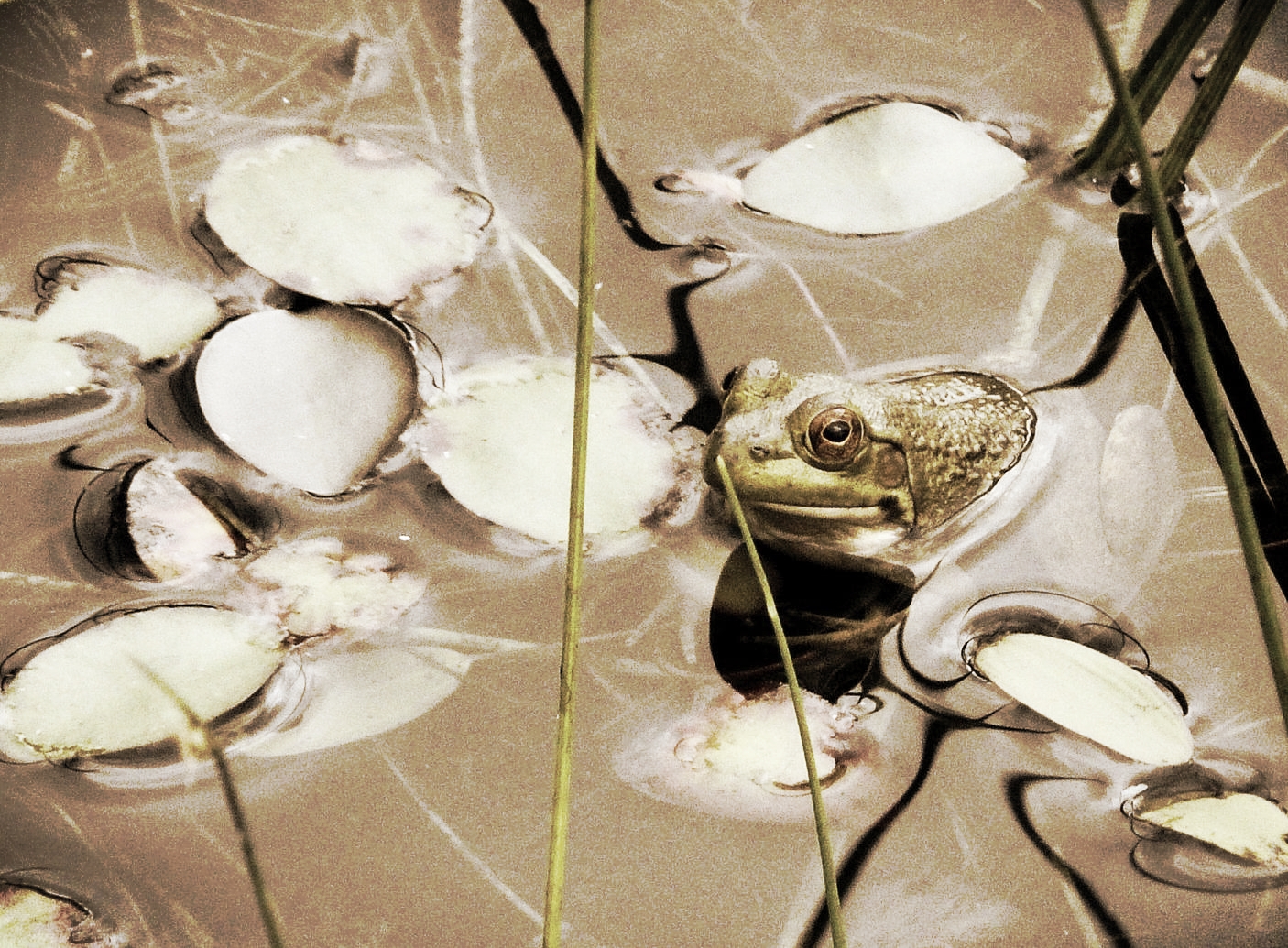
And this is the truth about change—it comes with work. And it comes with loss. It comes with holding the damage, and it requires a certain patience and perseverance. I once read that “The quickest way for a tadpole to become a frog is to live loyally each moment as a tadpole.”

If the changes we dread contain our salvation—then the antidote is our ability to stay loyal to the process. I don’t know about you, but that tadpole-ish  feeling is the one I run from the most. Discussion about change in the abstract is great—but to really sit there in that awkward phase where you literally have to grow legs? Really? How do they do it—those tadpoles? How can you live loyally this metamorphosis?

Tadpole really would be the perfect mascot for growth—wouldn’t it? It fits so much better, really, than caterpillar and butterfly—a metaphor I really like, but never feel like “it” has happened—that moment when you are all beautiful and colorful and the awkwardness is gone.

To live loyally as a tadpole would be a radical act of kindness—to yourself through change. Because I think what trips us up the most isn’t the change –the thing we want to be different. It’s the process we have to go through to get there. We want Spring. We don’t want a slow, cold March. We want to have legs, we just dread the process of growing them. It’s so uncomfortable this period of growth. Yes we want to be able to leap on those legs. We long for it, but we ignore metamorphosis as a stage in it own right. With its own beauty. With its own gifts. With the salvation it brings.

© 2015 Gretchen L. Schmelzer, PhD

Can people really change? How to Understand Growth for Adults and Kids.

When you plant lettuce, if it does not grow well, you don’t blame the lettuce. You look for reasons it is not doing well. It may need fertilizer, or more water, or less sun. You never blame the lettuce. Yet if we have problems with our friends or family, we blame the other person. But if we know how to take care of them, they will grow well, like the lettuce. Blaming has no positive effect at all, nor does trying to persuade using reason and argument. That is my experience. No blame, no reasoning, no argument, just understanding. If you understand, and you show that you understand, you can love, and the situation will change.
— Thich Nhat Hanh

I work as a therapist. I work as a consultant. I work as an executive coach. And I have heard this question hundreds, if not thousands of times over the course of my career. "Can people really change?" And behind that question is actually the statement, "I mean, he’s always going to be that way right? I mean, there’s no point in even getting him help, if he can’t change.”

The psychologist Gordon Allport once said that the definition of personality was essentially that you know who you are when you wake up tomorrow. So yes, there is something enduring about each of us. Some thread that runs through all of our years and make each of us who we are—so there is something in us that feels unchangeable. And indeed when those things do change—typically because of brain injury or memory loss—then we know longer feel like ourselves and people feel like they lost ‘us.’

So what do we mean when we talk about change?  We don’t question whether babies and children can change. We pray that our teenagers will change. But somehow when we get to adulthood we believe in a fixed notion of a person.  That they will essentially be who they are. So why bother with change—either my own or supporting someone else.

One of the problems is that change is a big topic. I can change my behavior: I can stop smoking or start exercising. I can shift my mindset and way of making meaning in the world: I can start taking another person’s perspective in a new way, or see a situation from multiple viewpoints—which I might call growth, but growth is change. I might use a behavior change to trigger growth: I might use behavioral change to stop interrupting people so that I am a better listener and with this change I can better understand other people’s perspectives.

Neuroscience, as I wrote about in the Norman Doidge book review, states unequivocally that our brains can, and do, change. Brains are designed with neuroplasticity—and our brains will change based on what we do: they will shift to match their use. So at the neural level the answer is OF COURSE PEOPLE CAN CHANGE.

But all of us, every single one of us also knows that, it can be really difficult to make change. It is difficult to  shift something, to learn something new. This is why we find ourselves doing that same, frustrating thing, over and over again.

The question about whether people can change does make you want to take out the old joke about the light bulb. You know the one: How many therapists does it take to change a light bulb? Just one, but the light bulb has to really want to change. And our motivation for change, our readiness for change and how change is connected to what matters to us most all impacts our capacity for change.

But today I want to highlight the way we support ourselves and the way we think about change at all.

When I think about change I always start with the gurus of change: children. Why? Because in the right environment children grow beautifully, on their own trajectory. Even kids who have some big struggles, if you get any of the obstacles even slightly out of their way, they shoot forward, back on track. I have to say that the human brain and spirit loves to grow. I have witnessed it over and over and it has made me a devout believer in growth. Thich Nhat Hanh described it perfectly. We don’t blame the lettuce for not growing. We must look at the conditions we are asking the lettuce to grow in.

And this is where I think we are terrible about growth in adulthood. In the best of circumstances children live in a world where they can safely lean on the adults around them—where the ‘soil’ of their lives is safe enough that they can spend their energy growing. The ‘dependence’ and security of their lives doesn’t make them helpless, it provides a safe platform from which to launch.

In psychological terms we call this safe platform a ‘secure base’ and it provides external stability and an internal sturdiness to weather the turmoil of growth and change. This is what change requires. A secure base—something that feels solid enough to lean on and leap from.

And my observations is that adults get all confused about needing support or stability. Either they get fixated on the idea of stability and security as the goal itself, and forget to let go and trust the internal sturdiness. Or, they are so frightened of leaning on anyone or anything else that they never feel safe enough to let go and try something new because they have to use all of their energy staying put and holding themselves together.

So much of the work I do isn’t getting people to change or making people change: it is getting them to create an environment that would allow them to grow or heal or change. My experience is that adults want to grow too. That just like the kids I have worked with, when you can clear obstacles they often shoot forward on their own power. So in many ways change is complicated for adults because they are both the creators of the soil of their garden, and the seeds they would plant.

For children, change is the constant. They are used to feeling off balance a lot, which explains a lot of the meltdowns we help them through. They use up a lot of energy managing the ups and downs of change and growth—and they often long for something familiar and stable. Which is why they always want to hear the same story over and over, or watch the same movie over and over.

Adults often notice that they go through big changes when life throws them a curve ball: when there is a death, or divorce, or a birth, or a change of job. It seems that adults often have to be thrown overboard from life in order to get back into the ocean of growth. So it seems so important to help people understand that the goal of stability in adulthood isn’t stillness or "having arrived." The purpose of stability is to create a springboard. If we thought of our ability to use our relationships, and supports and strengths less as a “safe house to live in” and more like ‘fixed ropes’ to climb with—we would have a different experience of adulthood and growth. Growth is the very definition of disequilibrium. And when we think of adulthood as this ‘solid, stable platform’ then when we feel off-balance, we think we are doing something wrong. But if we thought of adulthood as ‘great climbing gear’ then we would know that the experience of feeling off balance here and there was simply the experience of moving forward.

So this week—rather than thinking about what you want to change. Ask yourself what you can do to create better conditions in your life for growth and change. What can you do to make the ‘soil’ of your life better for your own growth? And ask yourself what your attitude about change is. How do you understand the days you are off balance? When your foot is on one ledge and your hand is reaching up toward a handhold? How can you help yourself enjoy the feeling of shifting from one spot to another?

© 2015 Gretchen L. Schmelzer, PhD